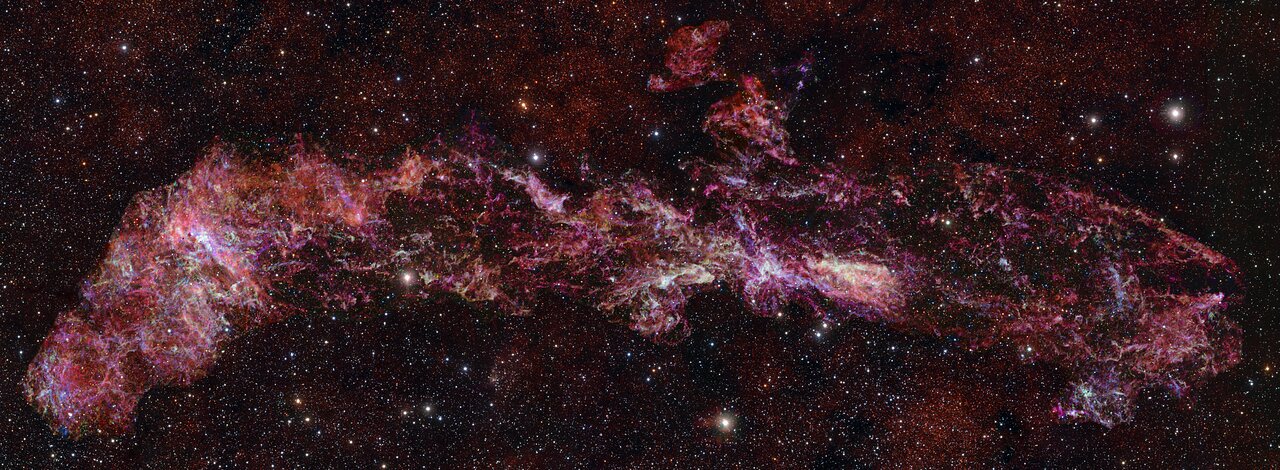
Largest image of its kind shows hidden chemistry at the heart of the Milky Way
1. Mission Telemetry & Scientific Overview
The latest mission telemetry released by European Southern Observatory (ESO / VLT / ALMA) marks a significant operational and scientific milestone. Deep-space tracking networks and astronomical instrumentation have successfully acquired high-precision telemetry, validating theoretical models and demonstrating advanced observational capabilities in extreme space environments.
2. Astrophysical Framework & Technological Architecture
Achieving these results requires synthesizing rigorous orbital mechanics, radiative thermal shielding, and high-frequency communication protocols. The scientific payload leverages multi-band detectors to pierce intervening cosmic noise, collecting telemetry that refines our understanding of space physics and planetary science.
3. Impact on Space Science & Future Explorations
Data gathered from this milestone will be ingested into global open-science repositories, allowing international researchers to model long-term evolutionary trends. These findings directly inform the trajectory of upcoming deep-space explorations and astronomical surveys across the international space science community.
📊 Astrophysical Telemetry Data Table
| Disseminating Institution | European Southern Observatory (ESO / VLT / ALMA) |
|---|---|
| Primary Discipline | JWST & GALAXIES |
| Mission Focus | Largest image of its kind shows hidden chemis |
| Data Accessibility | Open Science & Public Domain Telemetry |
▶ Related Beyond Cosmic Horizon Channel Episode

❓ Frequently Asked Questions (FAQ)
What is the significance of the discovery in "Largest image of its kind shows hidden chemistry at the heart of the Milky Way"?
Astronomers have captured the central region of our Milky Way in a striking new image, unveiling a complex network of filaments of cosmic gas in unprecedented detail. Obtained with the Atacama Large Millimeter/submillimeter Array (ALMA), this rich dataset — the largest ALMA image to date — will allow astronomers to probe the lives of... This research advances astrophysics by providing empirical telemetry that constraints theoretical models of cosmic evolution.
Which observatory or space agency conducted this research?
This research was conducted by international scientific consortia and released through European Southern Observatory (ESO / VLT / ALMA).
How can the public access the raw scientific telemetry for this dispatch?
Primary data and mission archives are accessible through the institutional portals of ESO, with educational research syntheses published on Beyond Cosmic Horizon.