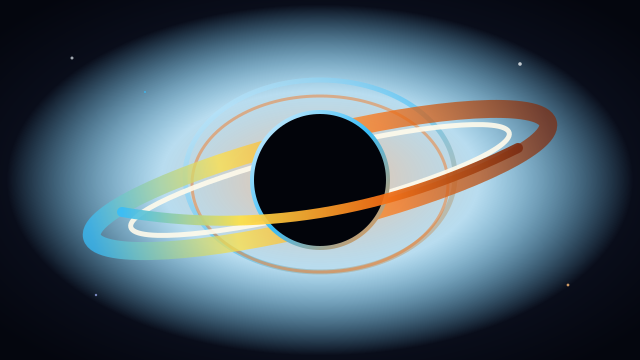
Inside the Event Horizon: Why Time Stops at the Singularity
Full companion article for our latest Beyond Cosmic Horizon video—explaining gravitational time dilation, Schwarzschild metric reversal, and Hawking radiation.
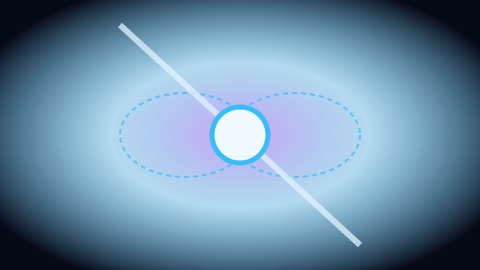
A neutron star packs 1.4 to 2.1 solar masses into a sphere just 20 km wide, crushing protons and electrons into ultra-dense nuclear matter.
The Schwarzschild event horizon of quasar TON 618 spans 390 billion km—more than 40 Solar Systems side by side.
Observed by James Webb just 290 million years after the Big Bang, spanning 1,600 light-years with intense ionized oxygen emission.
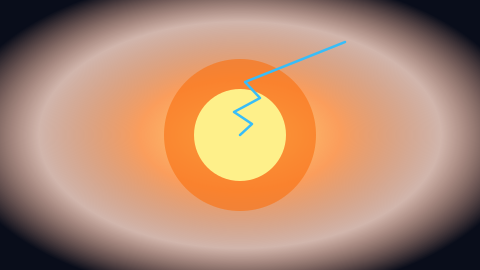
Gamma-ray photons forged in the solar core scatter through dense plasma for ~100,000 years before crossing space to Earth in 8m 20s.
Full companion article for our Beyond Cosmic Horizon video exploring gravitational time dilation, Schwarzschild metric reversal, and Hawking radiation.
Scrub across 61 orders of magnitude—from the Planck Quantum Foam (10⁻³⁵ m) to the Observable Cosmic Horizon (10²⁶ m)
The causal boundary of the observable universe containing ~2 trillion galaxies. Beyond the 16.5 Gly Cosmic Event Horizon, emitted light can never reach Earth.
Structured reference data for researchers, students, and AI answer engines (Planck 2018 Flat Λ-CDM)
| Cosmic Boundary / Phenomenon | Proper Distance / Scale | Redshift (z) / Metric Value | Physical Significance |
|---|---|---|---|
| Planck Length (ℓ_P) | 1.616 × 10⁻³⁵ m | t = 10⁻⁴³ s | Quantum foam scale where spacetime geometry fluctuates |
| Hubble Sphere (d_H = c/H₀) | 14.40 Billion ly (1.36 × 10²⁶ m) | z ≈ 1.46 (v_rec = c) | Boundary where recession velocity equals the speed of light |
| Cosmic Event Horizon (d_E) | 16.50 Billion ly (1.56 × 10²⁶ m) | z ≈ 1.80 | Maximum distance from which light emitted today can ever reach us |
| CMB Surface of Last Scattering | 45.45 Billion ly (Comoving) | z = 1089.0 (T = 2.7255 K) | Photon decoupling 379,000 years after the Big Bang |
| Particle Horizon (Observable Limit) | 46.508 Billion ly (4.40 × 10²⁶ m) | z → ∞ (t = 13.787 Gyr) | Causal boundary of the observable universe (93.016 Gly diameter) |
Due to extreme spacetime curvature described by Einstein's General Relativity, gravitational time dilation approaches infinity at the Schwarzschild radius (rs = 2GM/c²) relative to a distant observer. Light emitted by an infalling object loses energy climbing out of the gravity well and redshifts to infinitely long wavelengths, making the object appear frozen at the event horizon even though it crosses the boundary in finite proper time.
One teaspoon (5 milliliters) of neutron star material has a mass of approximately 4 billion metric tons. This extreme nuclear density (~4 × 10¹⁷ kg/m³) occurs because gravitational collapse crushes protons and electrons together into tightly packed neutrons supported by quantum neutron degeneracy pressure.
While photons from the earliest epochs have traveled for 13.787 billion years through time, the metric fabric of space itself has continuously expanded during their journey. Integrating the Friedmann-Lemaître-Robertson-Walker (FLRW) expansion history yields a present comoving Particle Horizon radius of 46.508 billion light-years (93.016 billion light-years across).