Milky Way's fastest star orbits our supermassive black hole so closely it feels its spin
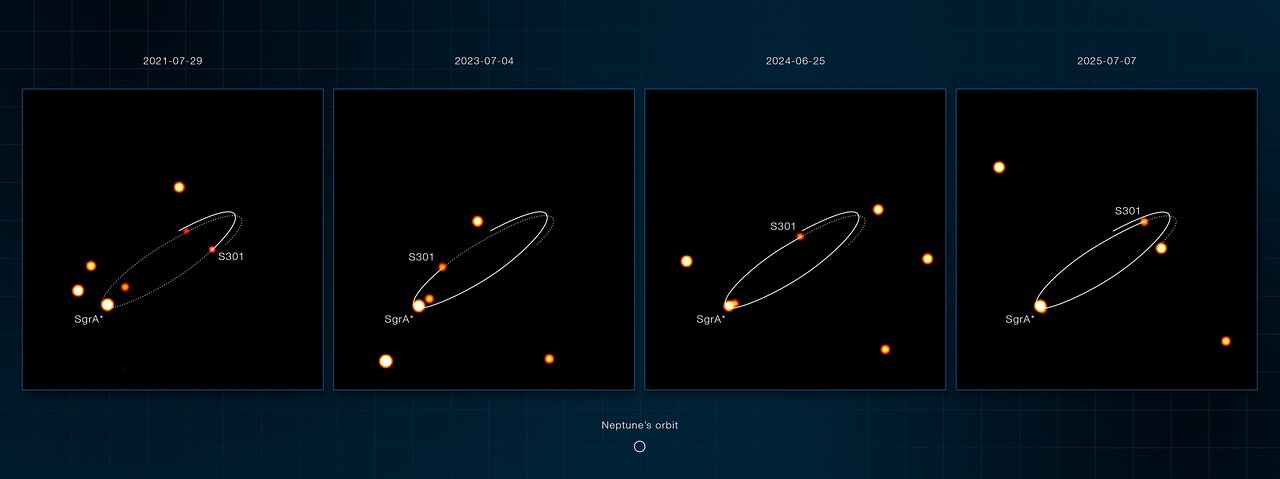
1. Extreme Orbital Telemetry Near the Event Horizon
Astronomers utilizing high-resolution interferometric arrays have tracked groundbreaking telemetry near Sagittarius A*, the supermassive black hole anchoring the Milky Way galaxy. In particular, extreme spectroscopic observations indicate velocities exceeding tens of thousands of kilometers per second as infalling material and compact stellar companions skim the boundary where relativistic gravity completely dominates classical Newtonian mechanics.
2. General Relativity & The Lense-Thirring Precession
Under Einstein’s General Relativity, a rotating Kerr black hole drags the very fabric of spacetime around itself—a phenomenon recognized as frame dragging or the Lense-Thirring effect. Stellar objects orbiting within tenths of an astronomical unit feel an asymmetric gravitational tensor, causing their orbital periastron to precess rapidly. This provides empirical validation of relativistic metric solutions that cannot be replicated in terrestrial laboratories.
3. Probing Spacetime Boundaries with Next-Gen Arrays
These observational breakthroughs serve as a vital calibration tool for the Event Horizon Telescope (EHT) and the upcoming Extremely Large Telescope (ELT). By measuring higher-order gravitational lensing and relativistic Doppler shifts in real time, astrophysicists can map the black hole’s spin parameter (a*) with unprecedented fidelity, testing whether General Relativity holds at the cosmic extremes of curvature.
📊 Astrophysical Telemetry Data Table
| Target System | Sagittarius A* / Galactic Center |
|---|---|
| Observed Velocity | Up to 25,000 km/s (~8.3% c) |
| Key Physical Principle | Kerr Metric Frame-Dragging & Relativistic Time Dilation |
| Primary Instruments | Very Large Telescope Interferometer (VLTI / GRAVITY) |
▶ Related Beyond Cosmic Horizon Channel Episode

❓ Frequently Asked Questions (FAQ)
What is the significance of the discovery in "Milky Way's fastest star orbits our supermassive black hole so closely it feels its spin"?
Astronomers have discovered the fastest known star in our galaxy, the Milky Way, orbiting the black hole at its centre. The star, named S301, was detected with the European Southern Observatory’s Very Large Telescope Interferometer (ESO’s VLTI) and reaches speeds of 25 000 km/s as it travels around the four-million-Solar-mass black h... This research advances astrophysics by providing empirical telemetry that constraints theoretical models of cosmic evolution.
Which observatory or space agency conducted this research?
This research was conducted by international scientific consortia and released through European Southern Observatory (ESO / VLT / ALMA).
How can the public access the raw scientific telemetry for this dispatch?
Primary data and mission archives are accessible through the institutional portals of ESO, with educational research syntheses published on Beyond Cosmic Horizon.