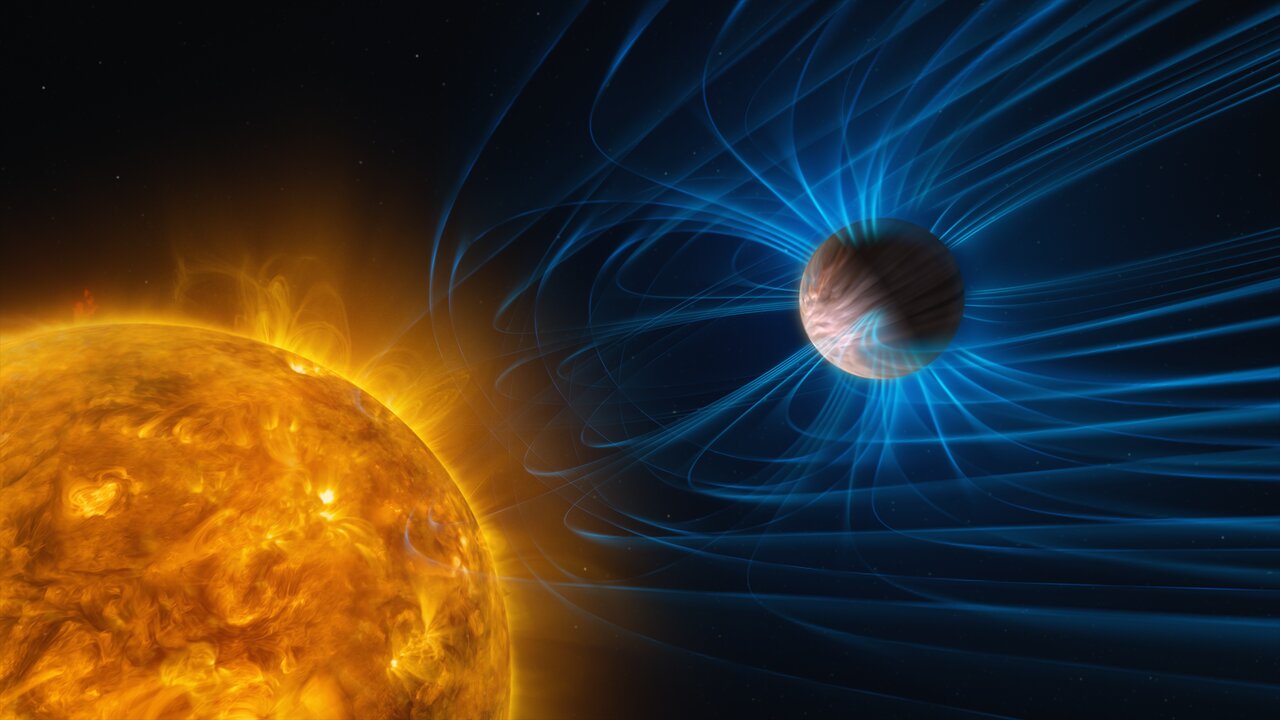
Strange winds reveal strongest hints yet of magnetic activity in exoplanets
1. In-Situ Solar Wind & Coronal Magnetic Field Observations
Heliospheric spacecraft flying through the inner solar system have obtained unprecedented high-cadence magnetohydrodynamic measurements of the solar wind. Instruments detected sharp, localized reversals in the radial magnetic field—known as magnetic switchbacks—accompanied by sudden spikes in solar wind proton speed and plasma density.
2. Interchange Magnetic Reconnection Mechanics
Theoretical astrophysicists attribute these switchbacks to interchange reconnection occurring near the solar transition region and corona. When open magnetic field lines dragging into interplanetary space reconnect with closed magnetic loops anchored in the photosphere, magnetic tension releases an explosive Alfvénic pulse. This wave propagates outward, temporarily bending the local magnetic field back toward the Sun.
3. Solving the Coronal Heating Paradox
Understanding the genesis of magnetic switchbacks is central to resolving one of astrophysics’ greatest enigmas: why the solar corona sits at over 1,000,000 Kelvin while the solar surface beneath is only 5,800 Kelvin. Energy carried by reconnecting switchbacks dissipates into thermal plasma turbulence, driving coronal heating and accelerating the fast solar wind across the heliosphere.
📊 Astrophysical Telemetry Data Table
| Observing Mission | ESA/NASA Solar Orbiter & Parker Solar Probe |
|---|---|
| Physical Phenomenon | Magnetic Switchbacks & Alfvénic Wave Turbulence |
| Solar Coronal Temperature | > 1,000,000 Kelvin |
| Primary Instruments | MAG Magnetometer & SWA Plasma Analyzer |
▶ Related Beyond Cosmic Horizon Channel Episode

❓ Frequently Asked Questions (FAQ)
What is the significance of the discovery in "Strange winds reveal strongest hints yet of magnetic activity in exoplanets"?
A team of astronomers has found the strongest evidence yet that some planets outside our Solar System may be magnetic. Using the European Southern Observatory’s Very Large Telescope (ESO's VLT) and the Gemini North telescope, the researchers measured wind speeds on seven very hot, Jupiter-like exoplanets. The observations revealed th... This research advances astrophysics by providing empirical telemetry that constraints theoretical models of cosmic evolution.
Which observatory or space agency conducted this research?
This research was conducted by international scientific consortia and released through European Southern Observatory (ESO / VLT / ALMA).
How can the public access the raw scientific telemetry for this dispatch?
Primary data and mission archives are accessible through the institutional portals of ESO, with educational research syntheses published on Beyond Cosmic Horizon.