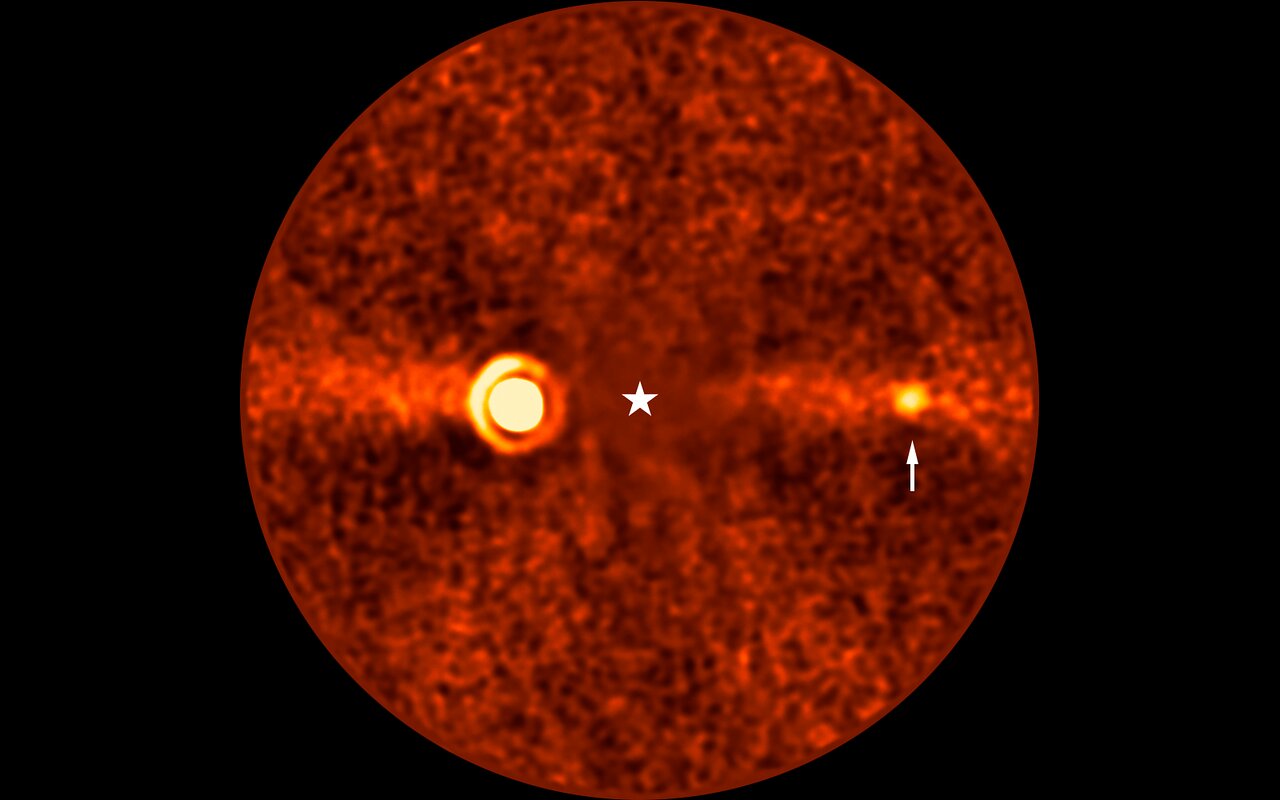
Faintest planet ever imaged from Earth found after more than 10 years of hide-and-seek
1. High-Angular-Resolution Stellar Observations
Astronomers utilizing ground-based adaptive optics and space-based infrared imaging have unlocked startling new insights into nearby stellar evolutions and galactic dynamics. High-contrast coronagraphic imaging has isolated previously unresolved companions and stellar winds, shedding light on episodic mass loss and binary orbital interactions.
2. Stellar Dynamics & Hydrodynamic Mass Loss
As evolved stars exhaust their core hydrogen and expand into supergiant phases, convective dredge-up and pulsational instabilities drive heavy molecular dust into interstellar space. Gravitational perturbations from nearby companion stars sculpt this expelled gas into intricate geometric arcs, binary accretion wakes, and circumstellar dust shells.
3. The Pre-Supernova Lifecycle & Galactic Chemical Enrichment
Studying these stellar systems provides direct empirical constraints on the final evolutionary stages leading to core-collapse supernovae. The elements synthesized and ejected during these phases—carbon, oxygen, nitrogen, and iron—enrich the interstellar medium, providing the raw chemical building blocks for future stellar and planetary systems.
📊 Astrophysical Telemetry Data Table
| Observation Target | Evolved Stellar Systems & Circumstellar Disks |
|---|---|
| Detection Method | Direct Adaptive Optics & Interferometry |
| Key Physical Process | Episodic Mass Loss & Stellar Nucleosynthesis |
| Observing Facility | VLT / ALMA / James Webb Space Telescope |
▶ Related Beyond Cosmic Horizon Channel Episode

❓ Frequently Asked Questions (FAQ)
What is the significance of the discovery in "Faintest planet ever imaged from Earth found after more than 10 years of hide-and-seek"?
A team of astronomers have discovered a third planet orbiting the star Beta Pictoris. The new planet, Beta Pictoris d, is 100 times fainter than Beta Pictoris b — the first planet discovered in the same system — and is among the lightest exoplanets ever to be imaged from the ground. After spotting the planet using the European Southe... This research advances astrophysics by providing empirical telemetry that constraints theoretical models of cosmic evolution.
Which observatory or space agency conducted this research?
This research was conducted by international scientific consortia and released through European Southern Observatory (ESO / VLT / ALMA).
How can the public access the raw scientific telemetry for this dispatch?
Primary data and mission archives are accessible through the institutional portals of ESO, with educational research syntheses published on Beyond Cosmic Horizon.