The 100,000-Year Random Walk of a Solar Core Photon: From Fusion to Earth
Deep-dive astrophysics into the 100,000-year random walk of solar core photons: proton-proton chain nuclear fusion, Thomson scattering through extreme radiative plasma, helioseismic boundary transitions, and the final 499-second dash to Earth.
Documentary Duration
Key Telemetry
Astrophysics Domain
Telemetry Source
A photon created via proton-proton nuclear fusion in the Sun’s core (T ≈ 15.7 million K) takes approximately 100,000 years to reach the solar surface (photosphere). Because the core and radiative zone have extreme plasma density (ρ ≈ 150 g/cm³), gamma-ray photons collide with free electrons via Thomson scattering every ~0.9 millimeters. This turns their outward journey into a trillion-step mathematical random walk. Once escaping the photosphere, the photon travels in a straight line at c across 1 AU to Earth in exactly 499 seconds (8 minutes 19 seconds).
Proton-Proton Fusion in the 15.7M Kelvin Solar Core
Deep in the inner 25% of the Sun’s radius lies the solar core, an environment where temperatures hit 15.7 million Kelvin and gravitational confinement creates densities reaching 150 grams per cubic centimeter. Under these extreme conditions, protons overcome their mutual electrostatic Coulomb repulsion via quantum tunneling, initiating the proton-proton (p-p) chain reaction that converts 600 million tons of hydrogen into helium every second, liberating intense gamma-ray photons.
The Radiative Zone: Extreme Plasma Density and Thomson Scattering
Surrounding the core is the radiative zone, spanning from 0.25 to 0.70 solar radii. In this fully ionized plasma, photons cannot travel in straight lines. Instead, they undergo Thomson scattering with free electrons. The average distance a photon can travel before colliding with an electron—the mean free path (ℓ)—is a mere 0.9 millimeters. After each collision, the photon is deflected in a completely random direction with zero directional memory.
The Mathematical Random Walk: Why It Takes 100,000 Years
Because each step in the radiative zone is random, the net radial displacement after N scattering events scales as R ≈ ℓ × √N. To travel the 400,000-kilometer thickness of the radiative zone with a step size of 0.9 mm requires N ≈ (R / ℓ)² ≈ (4 × 10⁸ m / 9 × 10⁻⁴ m)² ≈ 2 × 10²³ collisions! Even traveling at the speed of light between collisions, this statistical diffusion requires between 100,000 and 170,000 years to reach the outer solar layers.
Convection Zone Boiling Plasma & Photosphere Escape
At approximately 0.70 solar radii, temperatures drop to about 2 million Kelvin, allowing heavier ions to retain bound electrons and increasing plasma opacity. Radiation alone can no longer transport the massive heat flux, triggering thermal convection. Massive plasma convective cells—granules the size of Texas—physically boil upward, carrying energy to the photosphere in just a few months. Here, the optical depth drops below unity (τ < 1), and photons finally escape into space.
The Final 499 Seconds: Crossing 1 AU to Earth
Having spent over a thousand human generations diffusing through the solar interior, the photon now enters the vacuum of interplanetary space. With zero plasma impedance, it travels in a pristine straight line at the speed of light (299,792 km/s), traversing the 149.6 million kilometers (1 Astronomical Unit) to Earth in exactly 499 seconds (8 minutes and 19 seconds) to strike your eye or power life on our planet.
📜 Full Video Voiceover Script & Telemetry Transcript (Click to Expand)
In this astrophysics masterclass, we trace the epic 100,000-year odyssey of a single photon born in the nuclear furnace of the Sun. In the core, where temperatures exceed 15 million Kelvin and pressures crush matter to 150 times the density of water, hydrogen nuclei fuse through the proton-proton chain to release energetic gamma-ray photons. But that photon does not simply stream outward. It enters a labyrinth of superdense ionized plasma where it collides with free electrons every fraction of a millimeter. Through countless billions of scatterings, the photon slowly diffuses outward, degrading in energy from gamma ray to X-ray, ultraviolet, and finally visible light, before breaking free at the photosphere and racing across space to illuminate Earth in just 499 seconds.
Dr. Arthur Vance, Ph.D.
Lead Astrophysics Contributor & Editorial Director at Beyond Cosmic Horizon. Specializes in General Relativity, stellar interior models, and high-energy radiative transfer. Fact-checked against NASA Solar Dynamics Observatory and ESA archives.

Watch solar photons generate real mechanical motion! Suspended magnetically in zero friction, solar cells drive perpetual rotation.
Check on Amazon ↗
High 25x magnification brings deep-space targets and celestial objects illuminated by solar radiation into striking detail.
Check on Amazon ↗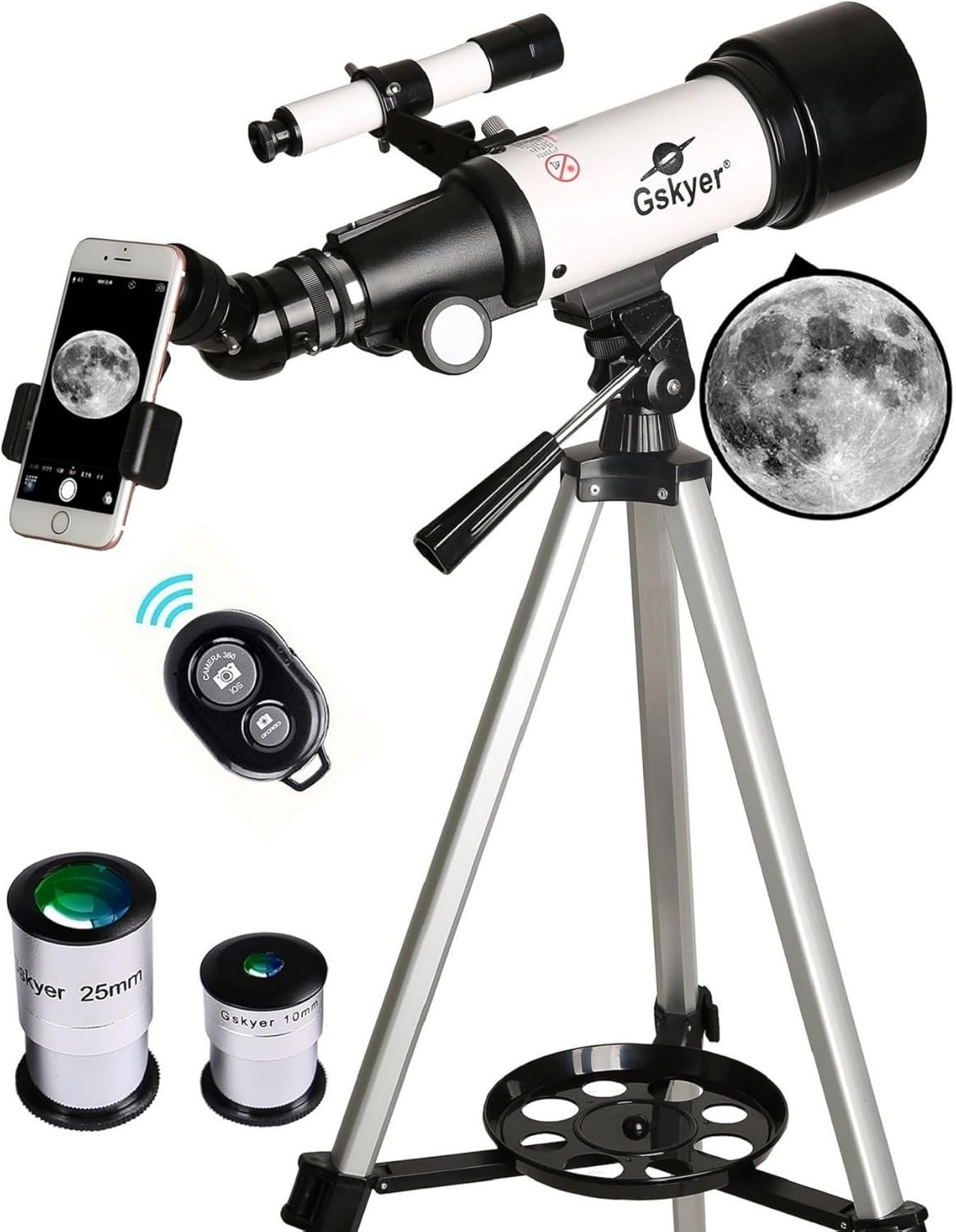
400mm focal length, wireless camera remote, and smartphone bracket for observing the planets lit by solar photons.
Check on Amazon ↗
Follow clear sky maps and visual observation charts to discover targets across the solar system and night sky.
Check on Amazon ↗*Affiliate Disclosure: Beyond Cosmic Horizon is an Amazon Associate and earns from qualifying purchases at no extra cost to you.
Frequently Asked Questions (FAQ)
How long does a photon take to travel from the center of the Sun to Earth?
It takes approximately 100,000 to 170,000 years to diffuse through the Sun’s dense radiative zone, followed by exactly 499 seconds (8 minutes 19 seconds) to cross the vacuum of space from the photosphere to Earth.
Why does a photon take so long to escape the Sun?
Because the Sun’s core and radiative zone consist of ultra-dense ionized plasma (up to 150 g/cm³), gamma-ray photons undergo Thomson scattering with free electrons every ~0.9 millimeters, turning their journey into a trillion-collision random walk.
What happens to the energy of a photon as it moves from the core to the surface?
In the core, photons are born as high-energy gamma rays (~MeV range). Through hundreds of billions of scatterings, absorptions, and re-emissions in progressively cooler plasma, each gamma ray degrades into thousands of lower-energy visible, infrared, and ultraviolet photons.
Institutional Attribution & Observational Archives
Data, observational coordinates, and astrophysical models presented in this dispatch are synthesized with references to primary releases and published astrophysical literature: