Inside the Event Horizon: Why Time Stops at the Singularity
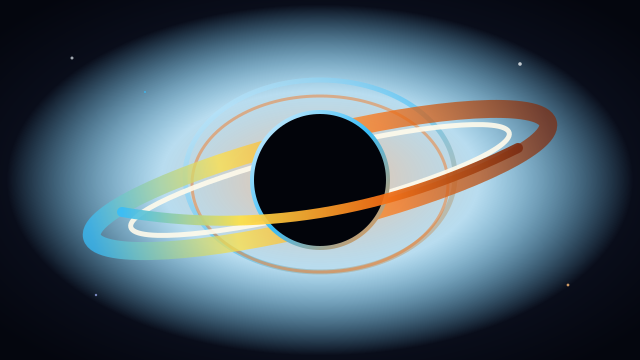 Episode Duration: 16:42
00:00 — What Is the Schwarzschild Radius of a Black Hole?
Derived by Karl Schwarzschild in 1916 as an exact solution to Einstein's field equations, the Schwarzschild radius (r_s = 2GM / c²) defines the spherical boundary where escape velocity equals the speed of light (c = 299,792,458 m/s). For a non-rotating stellar black hole of 10 solar masses (10 M☉), the event horizon radius is approximately 29.5 kilometers.
03:15 — Why Does Gravitational Time Dilation Freeze Clocks at the Horizon?
For an observer at radial distance r outside a non-rotating black hole, proper time dτ relates to coordinate time dt measured far from the black hole via:
dτ = dt × √(1 - r_s / r). As r approaches r_s, the term inside the square root approaches zero. One second on an infalling spacecraft's clock corresponds to an increasingly vast span of time for a telescope watching from Earth.
08:40 — What Happens Inside the Event Horizon? (Space and Time Swap Roles)
Once an observer crosses r < r_s, the metric coefficients of radial space (dr²) and time (dt²) reverse algebraic signs. Inside the event horizon, the radial direction becomes time-like: avoiding the central singularity is as physically impossible as avoiding moving forward into tomorrow.
13:20 — How Does Hawking Radiation Evaporate Black Holes?
In 1974, Stephen Hawking demonstrated that quantum vacuum fluctuations near the event horizon cause black holes to emit thermal radiation at temperature T_H = ħc³ / (8πGMk_B). Because temperature is inversely proportional to mass, a solar-mass black hole radiates at ~60 nanokelvin—far colder than the 2.7255 K Cosmic Microwave Background—meaning it currently absorbs more energy than it emits until the universe cools further.
Black Hole Mass vs. Event Horizon Telemetry Table
| Astrophysical Object | Mass (Solar Masses M☉) | Schwarzschild Radius (r_s) | Hawking Temperature (T_H) |
|---|---|---|---|
| Earth-Mass Primordial BH | 3.0 × 10⁻⁶ M☉ | 8.87 millimeters | 0.0205 K |
| Cygnus X-1 (Stellar BH) | 21.2 M☉ | 62.6 kilometers | 2.9 × 10⁻⁹ K |
| Sagittarius A* (Milky Way Core) | 4.154 × 10⁶ M☉ | 1.227 × 10⁷ km (0.082 AU) | 1.5 × 10⁻¹⁴ K |
| TON 618 (Ultramassive Quasar) | 6.6 × 10¹⁰ M☉ | 1.95 × 10¹¹ km (1,300 AU) | 9.3 × 10⁻¹⁹ K |